Key takeaways
- Treat maintenance as a fixed schedule, not a response to complaints: daily staff checks plus professional service monthly to quarterly.
- A short walk-through before guests arrive catches dead consoles, missing safety keys, loose cables and spills within hours instead of days.
- Clean with products the equipment manufacturer approves, and never spray liquid directly onto a console.
- When something breaks, disable it, tag it, log it and report it right away, and track repeat failures to plan replacements.
Why hotel gyms wear differently
A hotel fitness center is a hard place for equipment. Rooms are often open from early morning to late at night, some around the clock, and most are unstaffed. Guests don't know the machines, rarely report problems, and may keep using a treadmill that's making a strange noise because they're only in town for one night. Constant disinfecting wears on consoles and upholstery, and small rooms with limited ventilation run warm.
At the same time, the gym is one of the amenities travelers look for when they book. A broken treadmill doesn't inconvenience one person; it affects every guest who walks in that week, and some will mention it when they write about their stay. That's why well-run properties treat the gym like guest rooms: inspected daily, serviced on a schedule and fixed quickly.
The daily walk-through
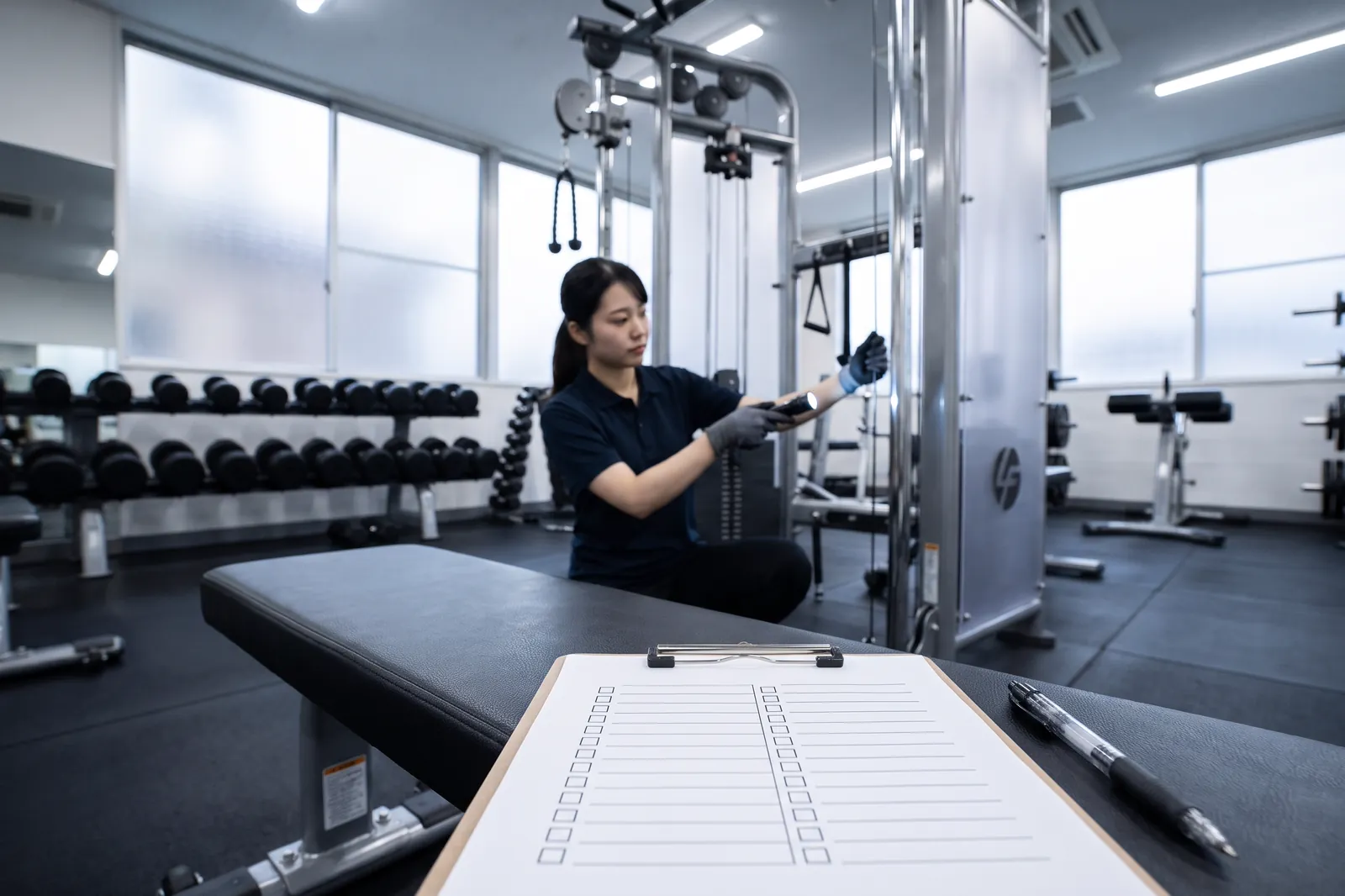
Assign the check to a specific role (engineering, maintenance, or a trained front desk or housekeeping staff member) and do it before the morning rush. It takes a few minutes:
- Power up each cardio machine and confirm the console lights with no error codes.
- Make sure every treadmill has its safety key and clip in place.
- Look along the cables on strength machines and functional trainers, and check that pins and handles are where they belong.
- Notice any hot or burning smell and any new noise.
- Check that floors are dry and clear, mats lie flat and no cords cross walkways.
- Restock towels, wipes and water, and empty the trash.
Anything wrong gets reported right away, not at the end of the shift. The full routine looks like this:
| Frequency | Task | Who |
|---|---|---|
| Daily, at opening | The walk-through above; wipe down touch points | Engineering or trained staff |
| Daily, at closing | Wipe machines, return pins and handles, restock, note issues for the morning | Housekeeping or staff |
| Weekly | Vacuum under and around machines (unplugged), check belt tracking, tighten accessible hardware, check upholstery | Engineering |
| Monthly | Full safety checklist: emergency stops, cables, pins, racks, floors and cords | Engineering |
| Monthly to quarterly | Professional preventive maintenance with a written service report | Technician |
| Annually | Review service records and repair history; plan replacements and next year's budget | Management |
The monthly step is covered in detail in the monthly gym equipment safety checklist, which can be printed and handed to staff.

Scheduled professional service
The properties with the fewest equipment complaints treat professional maintenance as a fixed monthly or quarterly line item, not something they call in after a guest complains. The right interval depends on hours and traffic: a busy hotel whose treadmills run most of the day may need monthly visits for cardio, while a smaller property can often work on a quarterly cycle. See how often gym equipment should be serviced for a usage-based guide.
A scheduled visit should cover cleaning inside motor compartments, lubrication, belt tension and tracking, cable and pulley inspection, hardware, electrical connections and a test of every safety feature, followed by a written service report that flags parts showing wear. Book visits for the quietest hours, usually midday, and give technicians one engineering contact who can open the room and sign off.
Managing a hotel fitness center? A preventive maintenance plan can be built around your guest hours, equipment list and building rules. Certified, licensed and insured technicians service all major brands on-site, and we'll follow up with a written quote.
When something breaks: the out-of-order protocol
- Stop it. Unplug powered equipment and remove the safety key so no guest can start it. On strength machines, remove the selector pin or handle.
- Sign it. Put a clear out-of-order sign on the machine and, if the room is unstaffed, at the entrance.
- Log it. Record what happened, any error code, a photo, and the make, model and serial number.
- Report it. Request service with those details; they speed up diagnosis and parts ordering.
- Tell the front desk, so staff can give guests an accurate answer and an expected return date.
Treat a gym repair with the same urgency as a broken air conditioner in a guest room. The more complete the request, the faster a technician can quote the gym equipment repair and arrive with the right parts.
Cleaning without damaging the equipment
Hotels clean gym equipment constantly, and cleaning is a surprisingly common cause of damage. A few rules keep it safe:
- Use cleaners and disinfectants the manufacturer approves. The owner's manual usually lists what's safe for consoles, plastics and upholstery.
- Spray the cloth, never the machine. Liquid sprayed onto a console or keypad can seep into the electronics.
- Skip harsh solvents and abrasive pads, which can crack vinyl, dull painted frames and cloud displays.
- Wipe sweat off frames every day. The salt in sweat slowly corrodes metal and fasteners.
- Keep spray bottles and wipe canisters off the machines themselves.
Tracking repeat problems and planning replacements
Keep a simple log for each machine: date, issue, repair and cost. When the same treadmill needs the same repair every few months, escalate instead of patching it again. It may need a larger component replaced, or it may have reached the end of its useful commercial life. The guide to repairing or replacing gym equipment walks through that decision, and the real cost of gym equipment downtime shows how to weigh what each outage costs.
An annual review of the log also supports capital planning: which machines to replace next year, which to keep, and whether the equipment mix still fits how guests use the room.
NYC logistics that slow repairs down
In New York, the delay is often access, not the repair itself. Help technicians get in and out quickly:
- Keep a current equipment list with makes, models and serial numbers.
- Ask for a certificate of insurance in advance if your building requires one.
- Book the freight elevator or loading dock ahead of time when parts or equipment are coming in.
- Name one engineering contact who can open the room and sign off on work.
When to call a technician
Call right away, and take the machine out of service, for a failed emergency stop, a frayed cable, a burning smell, a tripped breaker, a belt that slips or jerks, or an error code that returns after a restart. Call for scheduled service when it's due, and before your busiest travel season if the last visit was a while ago. A certified, background-checked technician comes on-site for treadmill repair and every other machine in the room, and you get a written quote before work starts.