
Key takeaways
- Pick the room for the equipment: basements suit most cardio, garages suit heavy strength gear, and spare rooms suit lighter machines.
- Protect the floor with rubber flooring, typically ¾ inch thick under racks and free weights.
- Measure the ceiling at its lowest point, under ducts and beams, not in the middle of the room.
- Treadmills need a grounded outlet, ideally on a dedicated circuit. Older panels may need an electrician’s check.
- Keep basement and garage humidity under about 60% to protect electronics and prevent rust.
Long Island homes usually have more room to work with than city apartments. Garages, basements and finished attics all make good home gyms. But the space has to be right for the equipment, and a few checks before you order save expensive surprises on delivery day. Use this checklist whether you’re in a Nassau County split-level or a Suffolk ranch.
1. Choose the right room
Each space has trade-offs. Match the room to the equipment you plan to put in it.
| Space | Best for | Watch out for |
|---|---|---|
| Garage | Racks, free weights, heavy machines; easiest delivery | Winter cold, summer heat, humidity, power supply |
| Basement | Most cardio and strength equipment; quiet for the house | Low ceilings, moisture, tight stairs |
| Spare room or finished attic | Bikes, rowers, ellipticals, lighter equipment | Floor loading, noise below, sloped ceilings |
2. Get the flooring right
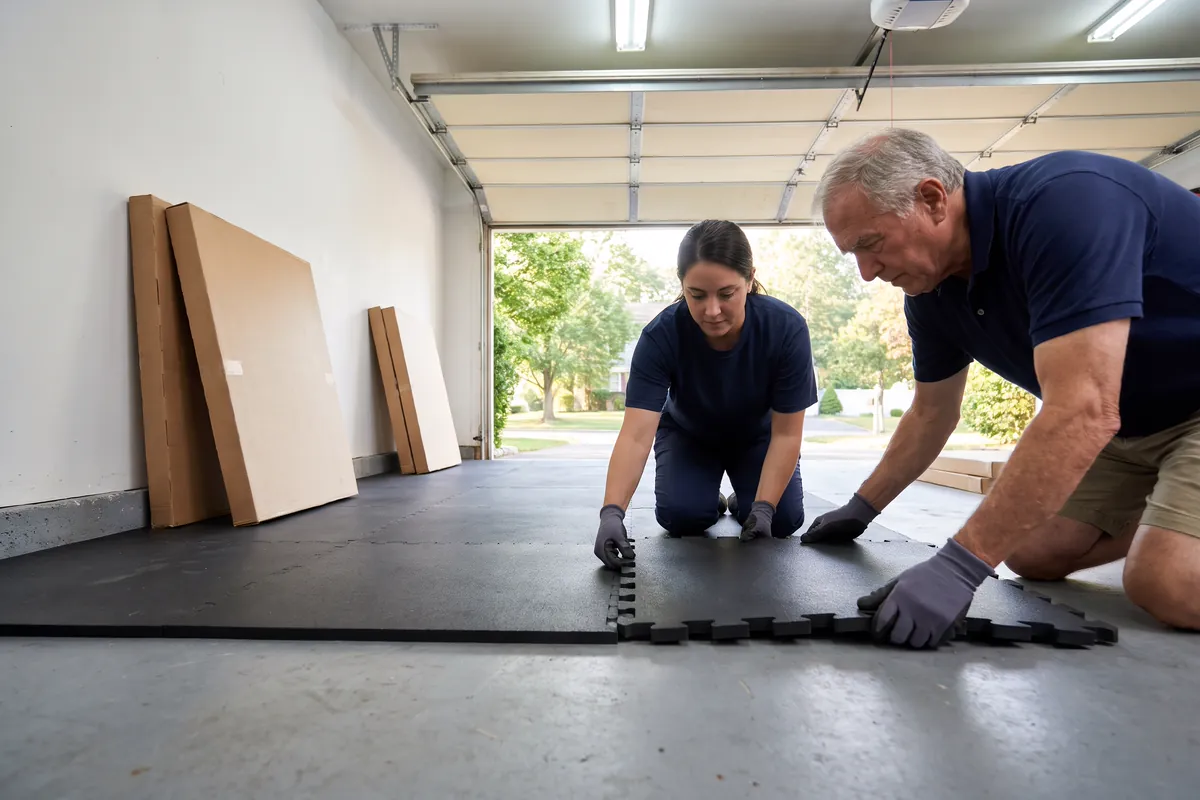
Concrete garage floors and finished basement floors both need protection from heavy equipment. High-density rubber flooring prevents cracked concrete and gouged finishes, keeps machines from creeping, and dampens noise and vibration that would otherwise travel through the house.
- Under racks and free weights: about ¾-inch rubber tiles or stall-style mats.
- Under cardio machines: a dense equipment mat or thinner rubber flooring is usually enough.
- On a basement slab: check for moisture first. Tape a square of plastic sheeting to the slab for a day or two; if the underside is damp, deal with the moisture before covering the floor.
- Over finished floors: some rubber can discolor vinyl or light flooring, so check with the flooring maker or use a barrier.
3. Measure the ceiling at its lowest point
Basements are where most layouts go wrong. Long Island basement ceilings often run about 7 to 8 feet, which is fine for most cardio, but ducts, beams and pipes can drop well below that. Measure under the lowest obstruction where each machine will stand.
- Treadmills: your height, plus the deck height at full incline, plus about 6 inches of headroom.
- Ellipticals: stand where the pedals will be at their highest point and check your head clearance.
- Racks: many full racks are around 7 to 7½ feet tall, and overhead presses and pull-ups need more room above. Shorter racks exist for low ceilings.
4. Plan the electrical before delivery
Treadmills draw real power. Running a treadmill, a bike and a fan off one older circuit can trip breakers, and extension cords or power strips can overheat and may void the warranty. Check the manual for the circuit your treadmill needs (many call for a dedicated circuit), and plan outlets so cords don’t cross walkways.
Garages and unfinished basements usually require ground-fault (GFCI) protection under electrical code, and some treadmills nuisance-trip GFCI outlets. If you’re adding motorized equipment, especially in an older home with an original panel, have a licensed electrician confirm the circuit meets both code and the manufacturer’s requirements.
5. Control humidity and temperature
Unfinished basements and garages often run more humid than the rest of the house, and homes in low-lying or South Shore areas can see more basement moisture. Damp air corrodes console electronics and rusts bare metal, chrome and weight stacks.
- Run a dehumidifier to keep humidity below about 60%, and check it with an inexpensive hygrometer.
- Keep machines on rubber flooring, not directly on a damp slab.
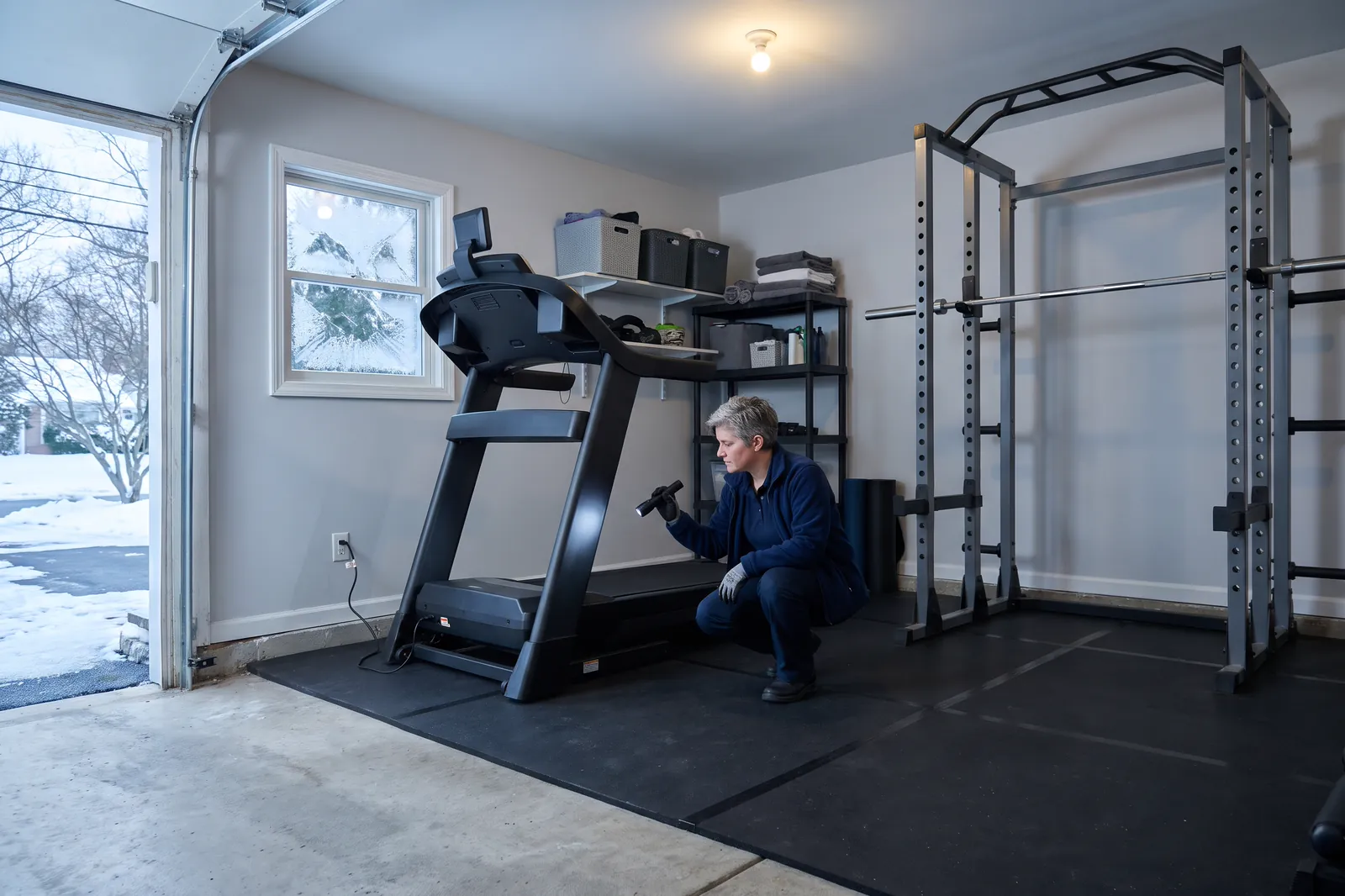
- In an unheated garage, let equipment warm to room temperature before turning it on after a cold night, so condensation doesn’t form on the electronics.
- If a basement ever takes on water, don’t power up equipment that sat in it until it has been checked.
More cold-weather advice is in these winter gym equipment care tips.
6. Plan delivery access and layout
A commercial-grade treadmill or a loaded rack often has to come through one specific door or down one specific staircase. Measure doorways, the stair width, any turn at the landing and the headroom over the stairs before you order; returns on heavy equipment are expensive. Bulkhead basement doors and garage doors can be the easiest way in.
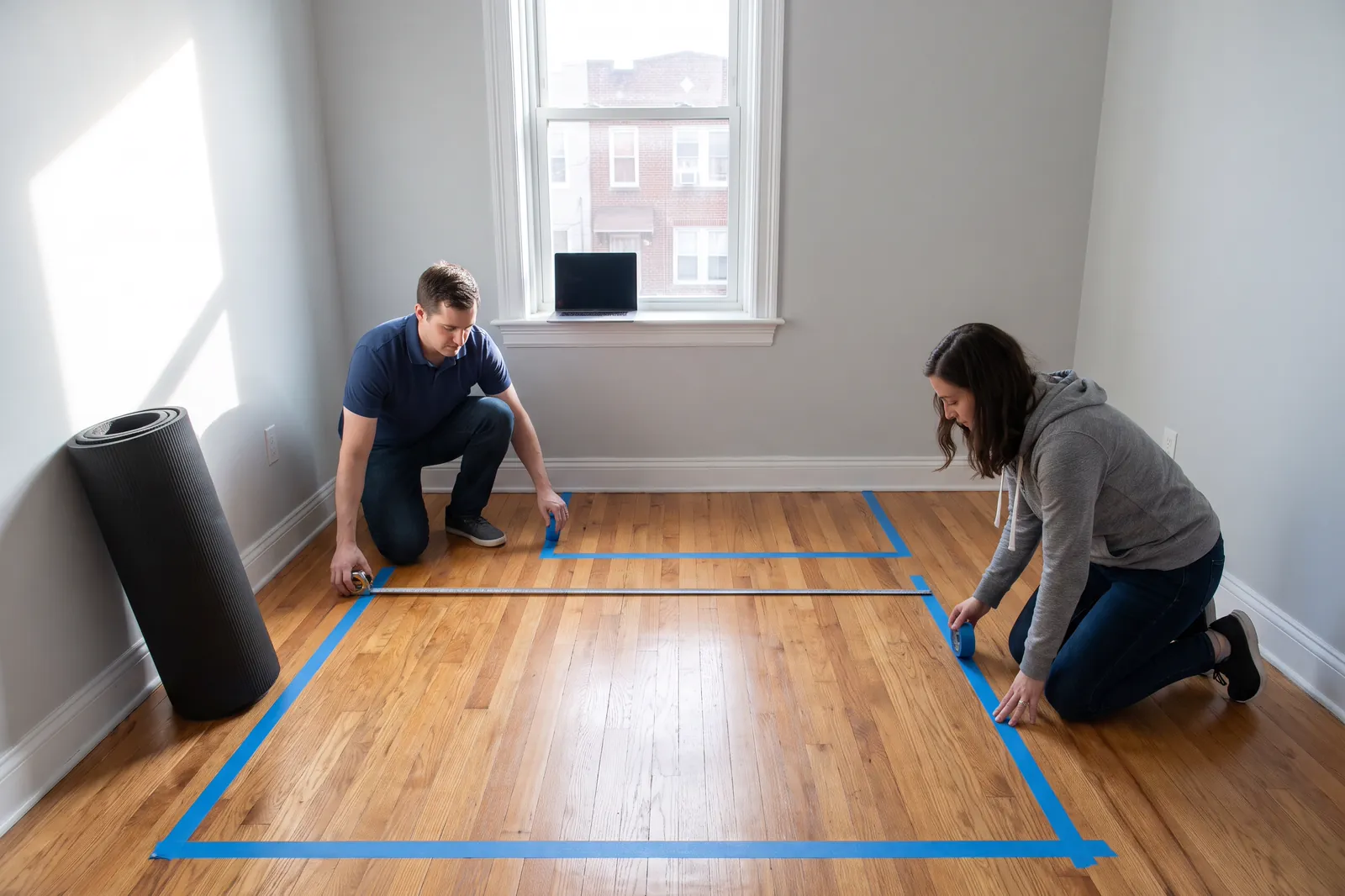
For layout, leave about 2 feet around cardio machines, about 6½ feet clear behind a treadmill, and roughly 4 feet behind and beside a rack for safe lifting. Leave room to reach every machine for cleaning and service.
Want it set up right the first time? Certified technicians handle professional gym equipment installation and assembly in garages and basements across Nassau County and Suffolk County: assembly, leveling, anchoring where needed and a full test.
7. Start with versatile equipment
Even with a whole basement, versatility beats a room full of single-purpose machines. A pair of adjustable dumbbells replaces a full rack of fixed weights. A rack with a bench covers most strength work. Add one cardio machine you enjoy, plus a suspension trainer or bands for mobility and core work. You can add more later, so leave space, outlets and flooring for it now. Buying secondhand? Run through the used gym equipment checklist first.
The quick checklist
- Room chosen to suit the equipment.
- Slab moisture checked; rubber flooring planned (¾ inch under weights).
- Ceiling measured at the lowest duct or beam.
- Grounded outlet, ideally on a dedicated circuit, near each motorized machine.
- Dehumidifier and hygrometer in place.
- Doorways, stairs, landings and headroom measured.
- Layout with clear space around every machine.
- Assembly plan for heavy and anchored equipment.
When to call a pro
Power racks, cable machines and heavy treadmills need careful assembly. Racks should be leveled and, in most cases, bolted to the slab with the manufacturer’s anchoring hardware. Don’t drill into a floor that may have radiant heating or buried lines without checking first. A rushed DIY assembly is a common cause of wobbly frames, misrouted cables and noisy machines.
Call a technician for anchoring and heavy assembly, a treadmill that trips the breaker, rust or corrosion appearing on a machine, or equipment that came through a basement leak. For ongoing care, a preventive maintenance plan keeps a home gym running smoothly.